
Accessible Skiing in Saas-Fee
Sean Rose: A Story of Resilience on Snow
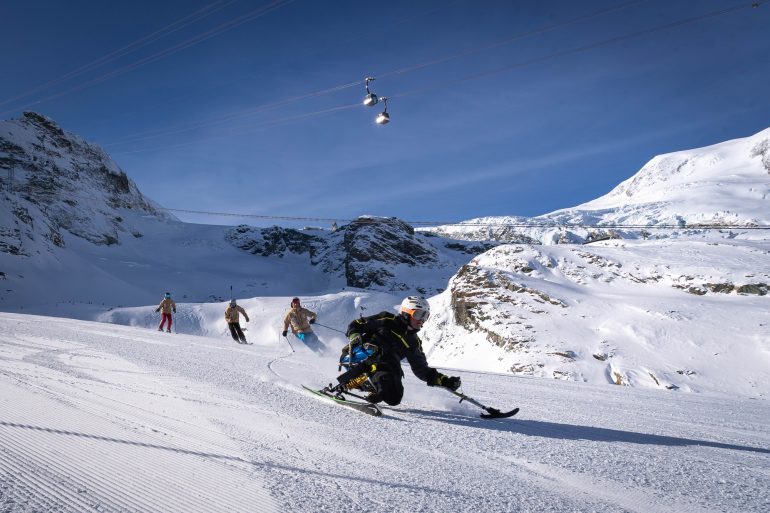
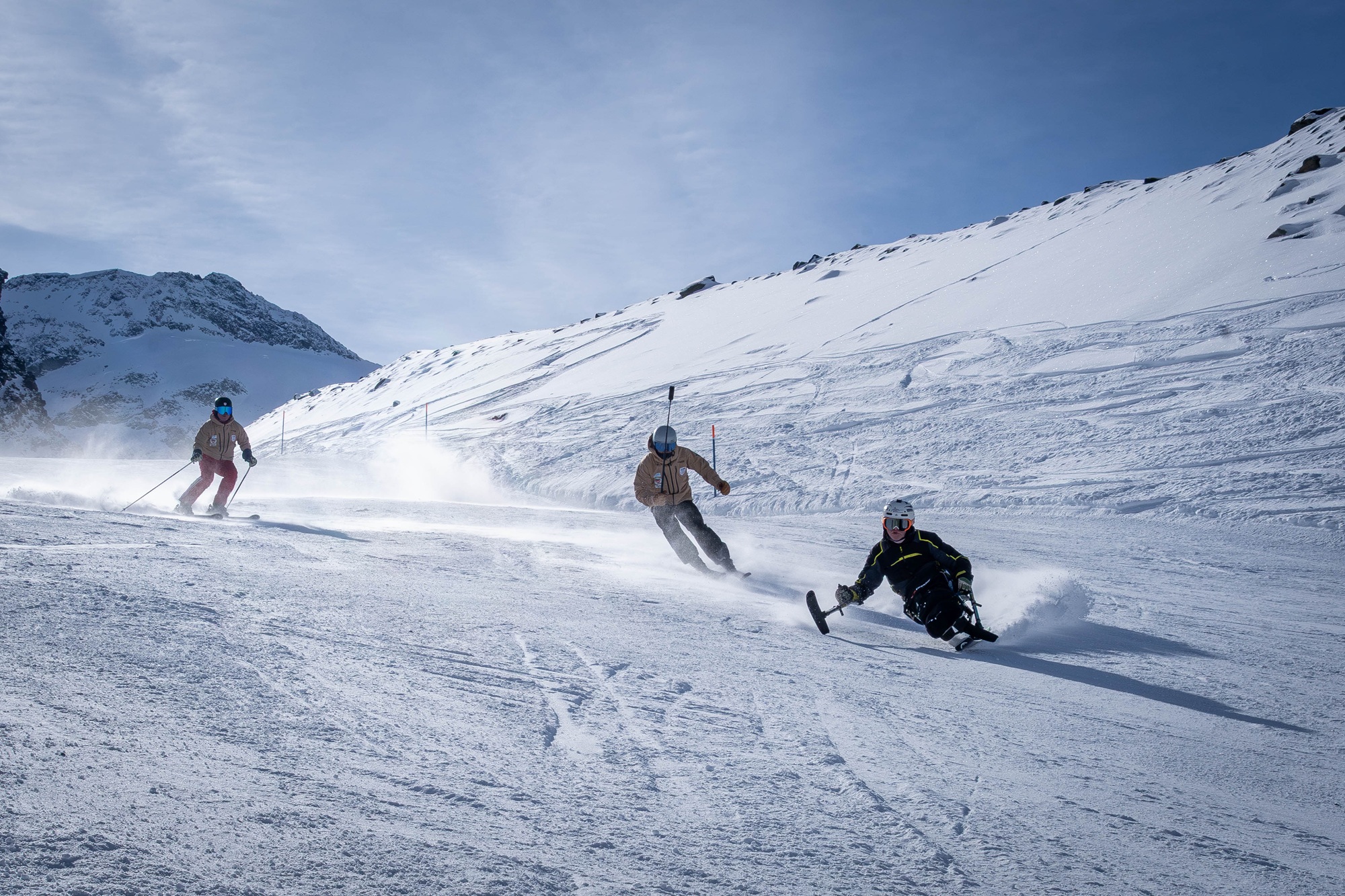
The glacier above Saas-Fee is wide and bright on this February morning. The snow is compact, the sky clear, the mountains sharply defined against the winter light. I’m on the slopes with Sean Rose, looking up at the mountains, as he makes the final adjustments to his sit-ski. Then, we’re off, carving down freshly groomed pistes.
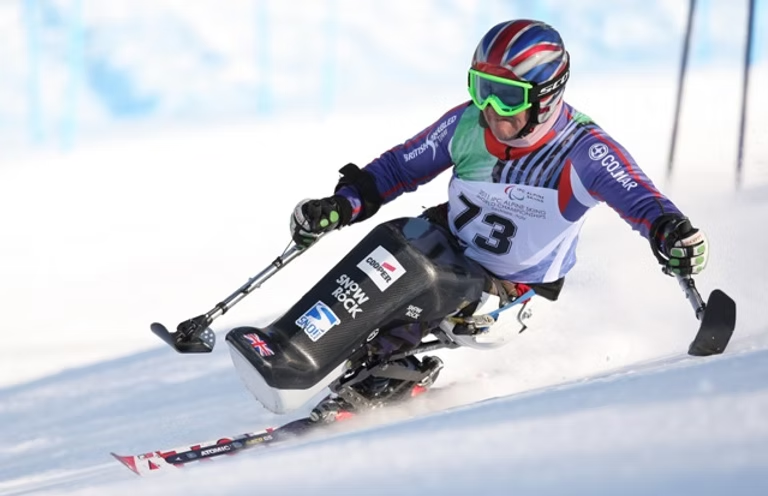
Rose is a former Paralympic alpine skier, World Cup medallist and Winter X Games competitor who represented Great Britain for more than a decade. Today, he runs the company Seated Sports, works as a speaker and travels to major sporting events as a television commentator. But on this morning in Saas-Fee, he is simply doing what has shaped his life for years: skiing.
“I can get quite emotional when I talk about skiing,” he says later, as we sit in a mountain restaurant over a coffee. “I always feel like a lump in my throat.”
Skiing defined his life long before it changed it. In 2000, he broke his back while skiing and sustained a spinal cord injury. The months that followed were uncertain and painful.
“There were some dark times,” he recalls. “Lots of times where I lay in hospital beds, just looking at the ceiling, thinking: what’s next? What about life?”
Even in those early days, he tried to look forward. He had served in the military, he explains, and believes that learning to adapt and overcome shaped his mindset. He began writing lists of things he thought he could still do — a way of forcing himself to focus on possibility rather than loss.
“Are you going to give up? Are you going to get on?” he says. “I just wanted to see the positive.”
A year after his accident, he went skiing with a charity organisation in Winter Park, Colorado — a trip designed for people with spinal cord injuries. He expected sit-skiing to feel like a compromise.
“I thought, I’m not going to enjoy this,” he says. “This will be boring in comparison to skiing before.”
It wasn’t.
“I made two turns and I just went… This is amazing!”
A Second Career on Snow
That moment marked the beginning of a second career. A few years later, he entered a local race in Colorado — a slalom organised as part of a fundraising event. It was run with a handicap start, and he was sent off several seconds ahead. For a moment, he believed he was setting the pace. But halfway down the course, another sit-skier flew past him at a completely different speed.
The experience stayed with him. It wasn’t enough to simply ski again — he wanted to compete.
Back home, he made a decisive move. He quit his job, packed up his life and moved to Canada to train properly. “I want to learn to race,” he had told his girlfriend. In Kimberley, British Columbia, he began training five days a week, building the technical and physical foundation required to compete internationally.
What followed was a decade-long professional career. Rose competed on the NORAM and World Cup circuits, represented Great Britain at the Paralympic Games and stood on international podiums — including a World Cup gold medal in Sestriere.
Beyond Equipment: Rethinking Accessibility in the Alps
It was during a mountain first aid course in the UK that Rose met Mike Laurenson. Between practical exercises and conversations about life in the mountains, the topic shifted to something larger than technique. Laurenson spoke about a new initiative taking shape in Saas-Fee — one designed to make the destination genuinely accessible for skiers with disabilities.
The idea resonated with Rose, because for many adaptive skiers, the challenge does not begin on the slope — it begins long before the first turn.
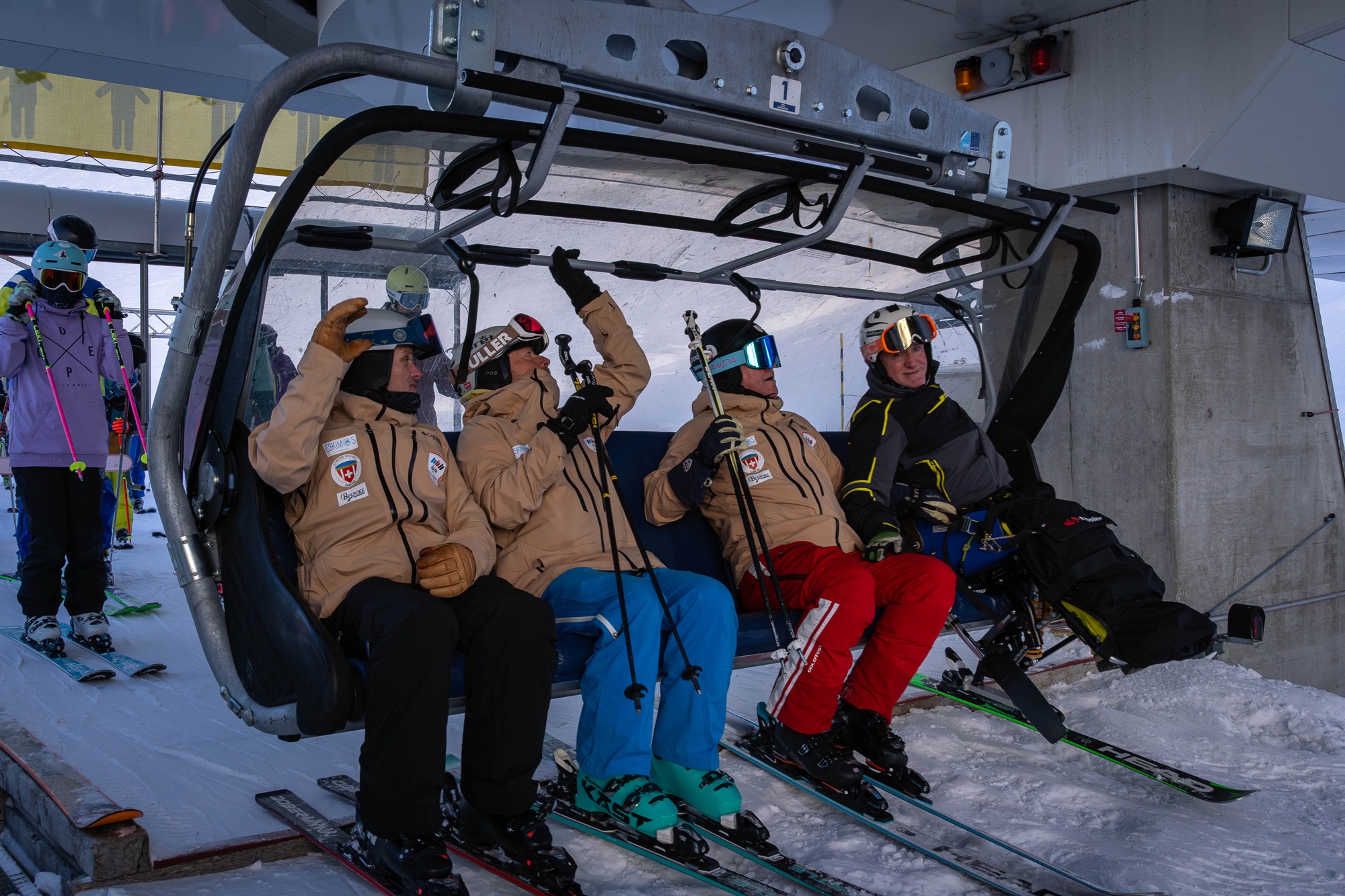
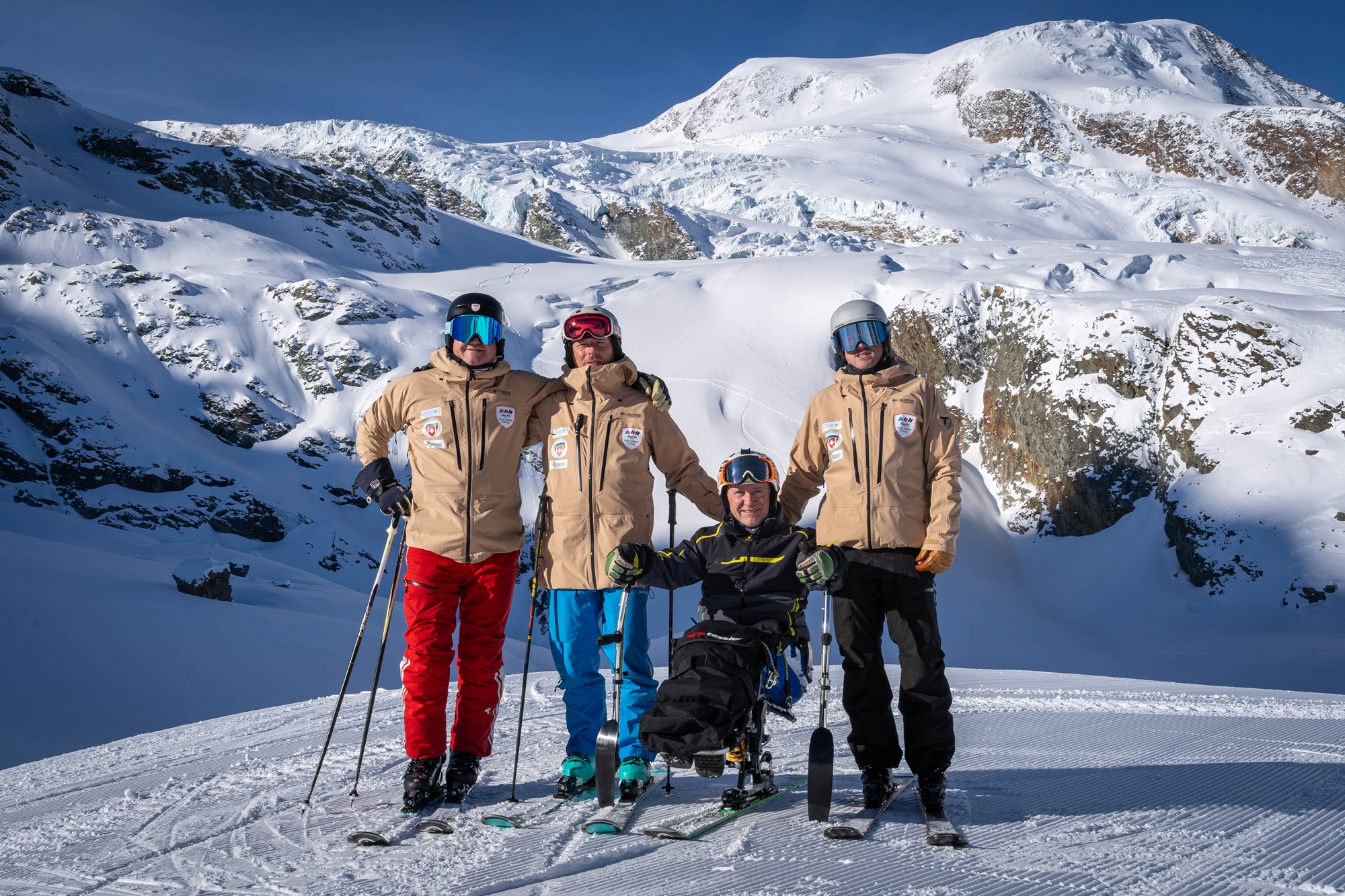
The Para-Alpine Skiing Initiative in Saas-Fee was founded by Mike Laurenson, Frank Bernath of Eskimos Ski School and Ben Shubrook of Bespoke Snowsports in collaboration with the Swiss Ski School Saas-Fee. It is designed to help people of all abilities enjoy skiing in an inclusive and supported way.
From the outset, the focus has extended beyond adaptive equipment alone. Specialised sit-skis and qualified instructors are essential, but accessibility, in this context, also means guidance and coordination. On request, the initiative supports guests in finding suitable accommodation, clarifies lift access and assists with organisational details — helping to create a seamless experience from arrival to departure.
In a high-alpine destination like Saas-Fee/Saastal, that broader approach matters. Many accommodations are barrier-free, and key highlights such as the Mittelallalin at 3,500 metres above sea level are accessible via the highest underground railway in the world, leading to the highest revolving restaurant in the world. From there, the Dom — Switzerland’s highest mountain at 4,545 metres — rises directly in front of you.
But infrastructure alone does not create inclusion. What makes the difference is having knowledgeable partners who understand both the mountain and the specific needs of adaptive skiers.
For Rose, that coordinated thinking is decisive.
“There are so many people out there that just want to try something new or enjoy the love of the mountains like we all do. But they need an opportunity.”
He believes accessibility works best when it is approached as a coherent whole.
“If it’s organised as a complete package, people will look at it and say: that’s where I want to go.”
During his stay in Saas-Fee, he tested slopes and lifts, experiencing the glacier and the village firsthand. The snow conditions, he says, are “incredible.” The skiing is “stunning.” And even with the practical realities of a sit-ski, the lift system “has been absolutely great.”
About the Para-Alpine Skiing Initiative Saas-Fee
The Para-Alpine Skiing Initiative Saas-Fee is a collaborative project by the Swiss Ski School Saas-Fee, Eskimos and Ski Zenit. Its goal is simple: making skiing in Saas-Fee accessible, inclusive and enjoyable for people of all abilities.
What’s offered:
- Personalised support before and during your stay – from barrier-free accommodation and lift access guidance to planning a fully tailored adaptive ski experience.
- Adaptive equipment for beginners and experienced sit-skiers alike, including Bi-Unique sit-skis, Tessier Tempo Dualski and Monoski models, Praschberger Monoski and the Tessier Snow Kart.
- Professional instruction by specially trained instructors with expertise in para-alpine skiing, offering lessons for all levels.
Who’s it for:
The initiative supports adults and children with reduced mobility, visual impairment or cognitive disabilities who wish to experience the joy of skiing in Saas-Fee.
Contact:
Para-Alpine Skiing Saas-Fee
Obere Dorfstrasse 62, 3906 Saas-Fee, Switzerland
📞 +41 78 332 44 08
📧 enquiries@paraalpineskiing-saas-fee.ch
On Risk, Progression and Perspective
Earlier that morning on the glacier, his turns had been smooth, precise and controlled. The technical foundation of a former elite athlete was unmistakable — in his balance, his line choice, his timing. Years of professional racing were still visible in every movement.
With a background in downhill racing — one of skiing’s fastest and most demanding disciplines — the subject of risk is never far away.
Asked about it, Rose does not describe himself as reckless.
“I love living on that little edge. It’s not crazy anymore because I just did a little bit more every day.”
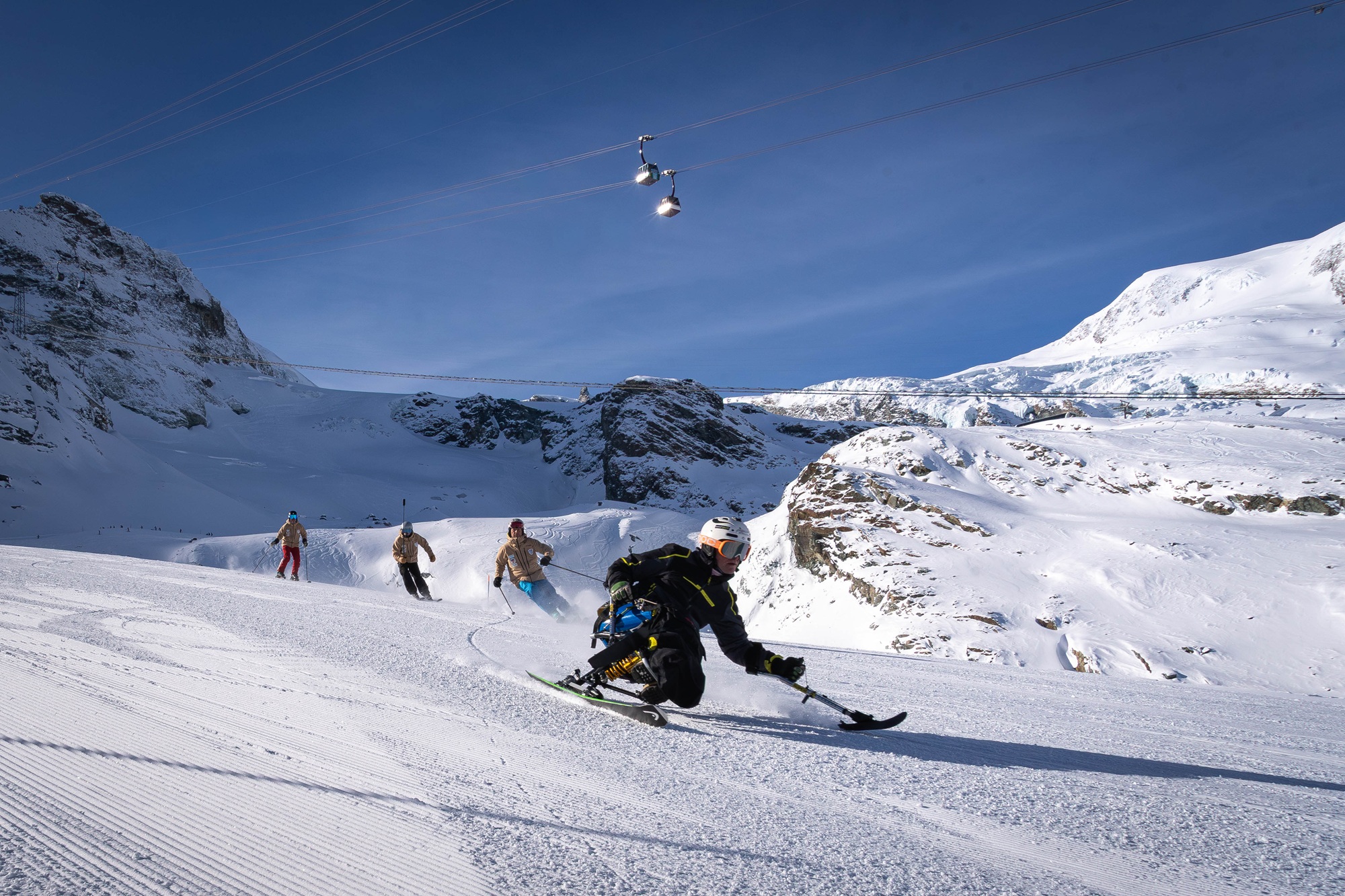
For him, progression was never about one dramatic leap. It was about building gradually — pushing slightly further each time, learning limits and expanding them step by step until what once felt intimidating simply became the next level.
That same philosophy shapes how he speaks about setbacks. He calls them “speed bumps of life.” They slow you down, he suggests, but they are not the end of the road.
“Would you rather look back in life and say I can’t believe I did that or I wish I’d done that?”
Today, Rose no longer competes. In March 2026, he will travel to the Paralympic Winter Games in Italy, where he works as a television commentator. After years of racing himself, he now analyses the runs, tells the athletes’ stories and brings the perspective of someone who knows exactly what it feels like to sit in the start gate.
Before we head back to the slopes, I ask him one final question: what does freedom mean?
“Freedom means the ability to be independent.”
On skis, that independence becomes movement. And on this February morning in Saas-Fee, it was visible in every turn.